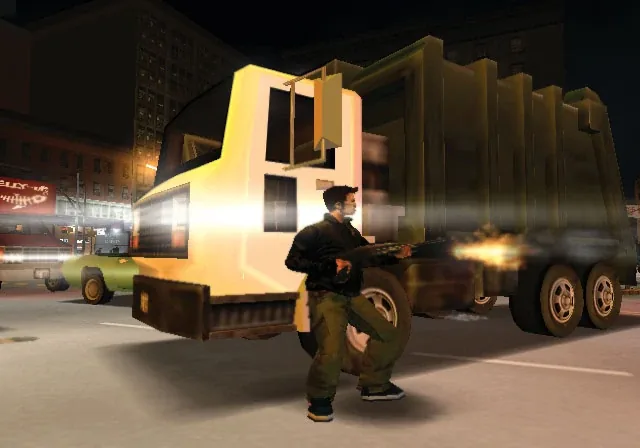
Grand Theft Auto III has approximately 80 main-story missions spread across three islands. Twenty-five years later, ten of them remain canonical — quoted in YouTube retrospectives, replayed annually, still cited as the foundation of modern open-world mission design.
1. "Give Me Liberty"
The opening tutorial mission. Claude is being transported in a prisoner van after the bridge collapse; the van is ambushed, Claude escapes, meets 8-Ball at the bomb shop, and gets his first weapon. The mission that established Rockstar's "playable opening cutscene" template — every later GTA opens with a similarly cinematic onboarding sequence.
2. "Luigi's Girls"
The first proper mission. Claude is sent by Luigi Goterelli to collect a sex worker from another part of Portland and bring her back to the Sex Club Seven. Establishes Liberty City's tone in 90 seconds — Portland streets, hostile Triads en route, the Sex Club's neon. Functional as a tutorial; iconic as the moment GTA III's tone clicks into place.
3. "Salvatore Called a Meeting"
The first big betrayal. Salvatore Leone summons Claude to the Saint Mark's restaurant; on arrival, the building is rigged with a bomb. The mission ends with Claude escaping and Salvatore's network turning on him. Triggers the bridge to Staunton Island and pivots the story into the second act.
4. "Bait"
The mission where Maria Latore is introduced as a betrayal vector against Salvatore. Claude meets Maria at the docks; she explicitly turns on Salvatore on-screen. Sets up the entire second-act Yakuza arc and the third-act Cartel finale.
5. "Last Requests"
Asuka Kasen's setup mission. Claude takes Asuka to a series of Cartel locations across Staunton Island, killing Cartel operatives at each stop. The mission's interrogation-and-execution sequence with Miguel (the Cartel lieutenant) is one of the darker tonal beats in any 3D-era GTA — Asuka tortures Miguel for information while Claude waits silently.
6. "Espresso 2 Go"
A small contract job that's iconic for a different reason: it's the first proper bomb-the-coffee-stands mission Rockstar would lean on across the entire 3D and HD eras. Catalina's drug pipeline runs through coffee stands across the city; Claude blows them up systematically. The bomb-the-target template returns in San Andreas, IV, and V.
7. "Liberator"
Rescue Maria from the Cartel hideout in Shoreside Vale. The mission introduces the Patriot vehicle (military Hummer) and the helicopter mechanic. The drive across the dam at the end of the mission is the third-act tonal pivot.
8. "Marked Man"
Donald Love's farewell mission. Claude has been working various contract jobs for Love across the second and third acts; "Marked Man" closes that arc with Love disappearing under unclear circumstances. The mission's airport climax — taking Love to Francis International while pursued by hostile gangs — is the longest single chase in the game.
9. "Decoy"
A late-game Cartel disruption mission. Claude takes a decoy van across the city to draw Cartel attention while the Yakuza hits Catalina's main drug shipment. The split-attention design — your decoy is being chased, but the actual story beats are happening elsewhere — is structurally novel for 2001 and informs later Rockstar mission design.
10. "The Exchange"
The closing mission. Claude trades Maria for Catalina at Cochrane Dam; the dam fight, the helicopter chase, and the final sequence where Claude confronts Catalina are the campaign's setpiece. Catalina's death closes Claude's revenge arc that started on Callahan Bridge in the opening cutscene.
The final cutscene — Claude walking away from the dam with Maria, an off-screen gunshot, ambiguous fade-to-black — is one of the most-debated endings in any GTA. We covered the ambiguity in Catalina, Asuka, and the Women of GTA III.
Honorable mentions
- "Sayonara Salvatore" — the assassination of Salvatore Leone himself. Closes the first-act betrayal arc.
- "Ransom" — Catalina's first explicit re-appearance after the opening, kicking off the third act.
- "Mike Lips Last Lunch" — early bomb-rigging mission for Joey Leone.
- "Bomb Da Base: Act II" — explosive setpiece on a freighter; one of the rare GTA III missions with proper interior level design.
Why these missions still matter
GTA III's mission design is, by 2026 standards, simple. Most missions are: drive somewhere, kill someone, drive back. There's almost no scripted dialog during gameplay; cutscenes do all the talking; there's no checkpoint system. Failing a mission means restarting from the contact's location, often with a long drive back across the islands.
Yet the missions ranked above remain canonical because they established conventions: cinematic opening, multi-stage betrayal arcs, ally-and-enemy gang structures, scripted setpiece chases. Every later GTA mission is a refinement of patterns GTA III set in 2001.
For per-mission detail pages, see the GTA III missions database. For the broader story context, see GTA III's Story Primer.